
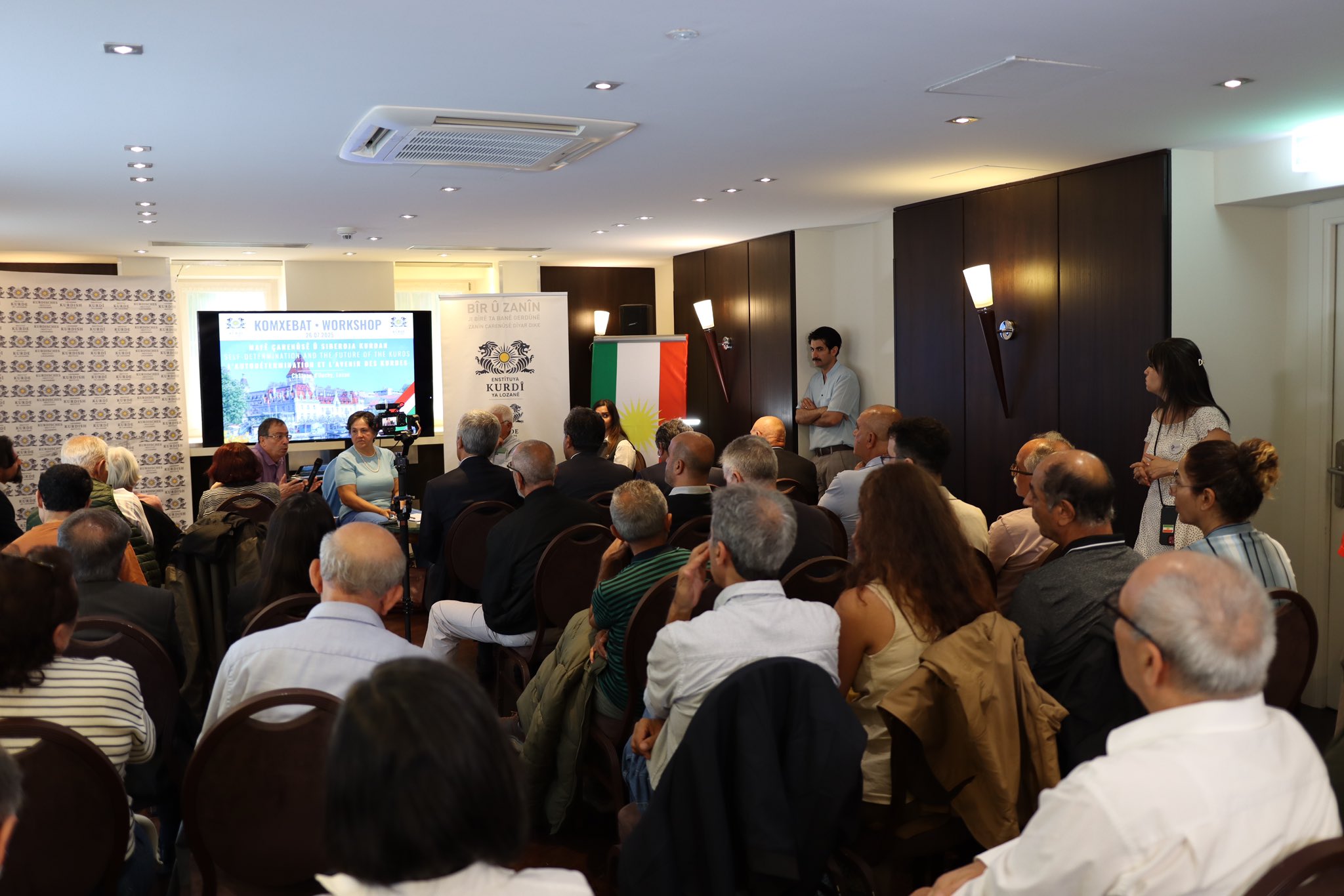
The Kurdish Institute of Lausanne (IKL), which announced its founding in May, organized a workshop titled "THE RIGHT TO SELF-DETERMINATION AND THE FUTURE OF THE KURDS" at the Château d'Ouchy in Lausanne, Switzerland, where the 1923 Treaty of Lausanne negotiations took place.
Numerous writers, academics, and Kurdish politicians participated in the workshop, which was held in three sessions.
In the first session titled "History and Law," writer Evin Çiçek, jurist Şeyhmus Özdemir, and attorney Celal Baykara, president of Kurd-Kav, delivered speeches.
In the second session titled "The right to self-determination and the nation," academic Sharo Garip from Bochum University in Germany, academic Behroz Şucai from Uppsala University in Sweden, and writer Diyax Polat delivered speeches and discussed the right to self-determination in the context of national sovereignty.
POLITICAL PERSPECTIVES
In the third session titled "Political Perspectives," HAK PAR chairman Düzgün Kaplan, PSK chairman Bayram Bozyel, PWK chairman Mustafa Özçelik, PDKS official Cemal Merai, and PAKURD chairman Gevran Goyi delivered speeches.
WORKSHOP DECLARATION
Following the sessions, Necat Zanyar, president of the Kurdish Institute of Lausanne, announced a declaration in Kurdish on behalf of the institute.
The workshop declaration stated that the right to self-determination is a universal right, enshrined in the preamble and Article 1 of the UN Charter, guaranteed in Article 1 of the 1966 UN twin covenants, and constitutes a peremptory norm of international law.
KEY POINTS FROM THE DECLARATION
- The Kurdistan cause is a national cause. It is not a matter of democracy, human rights, economic underdevelopment, or integration.
- Kurds should exercise their right to self-determination through democratic means and take ownership of their decisions and destiny.
- For 300 years since 1694, the Kurds have explicitly demanded national sovereignty.
- Iraq after 2003, Syria after 2011, the regime crisis in Iran, and the 40-year war in Turkey demonstrate that the status quo created by the Treaty of Lausanne has collapsed.
- The sovereignty crisis of religious communities such as Alevis, Druze, Yazidis, Sunnis, and Shias also continues.
- The federal administration in Southern Kurdistan and the autonomous administration in Rojava Kurdistan are important examples.
- The Kurds' right to self-determination is not a threat to coexistence in the region but rather a contribution to it.
- The unity of the Kurds and the peace of neighbors are fundamental.
- Kurds should support dialogue and negotiation processes in countries that dominate Kurdistan, but as long as the Kurdistan cause remains unresolved, such processes should not be described with concepts such as peace, brotherhood, and unity.